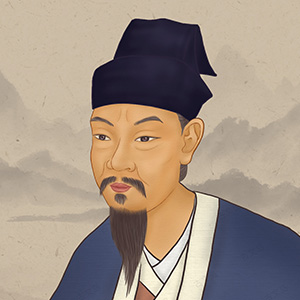
Liu Yuxi
刘禹锡
- 分类: 语言文学
- ID: 1867757935269847041
Home CategoryLiteratureLiu YuxiPlay6 minsLiu Yuxi, a prominent Tang Dynasty poet born in 772 in Luoyang, Henan, is renowned for his writings on life, nature, and society. Despite early recognition of his talent and a career in the bureaucracy, his political stances led to multiple exiles.ShareRelated Videos**Bamboo Shoots 00:03:17Catalogue1. Early Life and Background2. Literary Contributions3. The Poem Words of Autumn4. Influence and Legacy5. Cultural Impact6. Further Aspects of Liu Yuxi's Literary Work7. Exile and Return8. Comparative Analysis with Contemporaries9. Philosophical Underpinnings
Early Life and Background
Liu Yuxi was a prominent Chinese poet from the Tang Dynasty (618-907). He is best known for his distinctive writings that reflected his perceptions and feelings about life, nature, and society. Born in 772 in Luoyang, Henan province, Liu Yuxi was a talent recognized early in his life, which led him to pursue a career in the Chinese bureaucratic system, typical of many scholars of his time. However, his career was often marred by political turmoil, and he faced several exiles due to his political positions and affiliations.
Literary Contributions
Liu Yuxi is celebrated for his poetic works, which cover a variety of themes ranging from the beauty of nature to the depths of human emotion. His poem Words of Autumn is particularly notable for challenging the melancholic associations traditionally linked with autumn. Instead of seeing autumn as a time of decay and loss, Liu Yuxi suggests that it is a season of beauty that surpasses even that of spring. His ability to find beauty and hope in what is traditionally seen as a time of decline demonstrates his unique perspective and literary style.
The Poem Words of Autumn
The poem Words of Autumn reflects Liu Yuxi's appreciation for the natural beauty of the autumn season. He draws inspiration from the sight of birds flying in line against a backdrop of white clouds and a deep blue sky, a scene that he finds unique to autumn. The poem not only highlights his observational skills but also his ability to elevate ordinary experiences into profound reflections on life and nature. The poem challenges the reader to see beyond the common associations of autumn with sadness and to appreciate its unique, serene beauty.
Influence and Legacy
Despite the political challenges that he faced, Liu Yuxi's literary work has endured through the centuries, leaving a lasting impact on Chinese literature. His poems are appreciated for their depth, clarity, and ability to evoke emotion. While his physical presence has long since faded, the beauty he perceived in the world continues to resonate with readers today, ensuring that his legacy endures. His work encourages readers to appreciate the subtle beauties of life and nature, urging them to find joy and inspiration even in the least likely of places.
Cultural Impact
Liu Yuxi's work is often cited as an example of the rich literary heritage of the Tang Dynasty, a period often referred to as a golden age of Chinese culture. His poetry not only reflects his personal experiences and observations but also provides insight into the broader cultural and philosophical currents of his time. The themes of his work, such as the passage of time, the beauty of nature, and the resilience of the human spirit, continue to resonate with audiences today, highlighting the timeless quality of his insights.
Further Aspects of Liu Yuxi's Literary Work
Liu Yuxi's literary output was not limited to poetry. He also wrote essays and prose that dealt with philosophical and social issues of his time. His works often reflected his Confucian beliefs, emphasizing moral integrity and the importance of self-cultivation. Throughout his life, Liu Yuxi was deeply engaged in the intellectual debates of his time, and his writings often address themes such as the nature of government, the role of the individual in society, and the relationship between humanity and the natural world.
Exile and Return
Liu Yuxi's career as a government official was frequently disrupted by his political views and affiliations, which led to multiple exiles. However, these periods of exile were also times of significant literary production, as Liu Yuxi used the solitude and reflection these times afforded to compose some of his most profound works. His eventual return to the capital marked a renewal of his political career, but it also cemented his position as one of the leading literary figures of his time.
Comparative Analysis with Contemporaries
In the context of Tang Dynasty poetry, Liu Yuxi is often compared to his contemporaries such as Bai Juyi and Han Yu. While Bai Juyi is known for his accessible style and social critique, and Han Yu for his classical revivalism, Liu Yuxi's work is distinctive for its combination of personal reflection with broader philosophical musings. His ability to convey complex emotions and ideas with clarity and elegance marks him as a significant figure in the canon of Chinese literature.
Philosophical Underpinnings
Liu Yuxi's work is heavily influenced by the philosophical currents of Confucianism, Taoism, and Buddhism that characterized intellectual life during the Tang Dynasty. His poems often explore the transient nature of life, the search for inner peace, and the importance of maintaining moral integrity. These themes reflect the broader philosophical debates of his time and highlight Liu Yuxi's engagement with the key intellectual issues of his era. Article reference1. Art reflecting Chinese core values wins critical acclaim. chinadaily.com.cn. 20212. Tracing back traditional culture at Shigu Academy. chinadaily.com.cn. 2018Photo Gallery(1 picture)CategoriesLiteratureTagHistorical FiguresChinese PoetryRelatedShigu AcademyBaidi City•Qutang Gorge Scenic Area, ChongqingCatalogue1. Early Life and Background2. Literary Contributions3. The Poem Words of Autumn4. Influence and Legacy5. Cultural Impact6. Further Aspects of Liu Yuxi's Literary Work7. Exile and Return8. Comparative Analysis with Contemporaries9. Philosophical Underpinnings- - - []








